

XRP is in its deepest losing streak in more than a decade, even as Ripple aggressively expands into corporate finance and institutional infrastructure. The disconnect is forcing a key market question: why isn’t that momentum showing up in price?
XRP price is in its longest losing streak since 2014, a slide that has left one of the market’s oldest large-cap tokens searching for a fresh catalyst even as Ripple accelerates its push into corporate treasury, institutional trading, and cross-border payments.
Why this matters: Ripple is moving XRP closer to real financial workflows rather than speculative use. If treasury systems, trading desks, and payment networks begin integrating the asset at scale, it could change how demand forms. For now, the market is treating that transition as unproven.
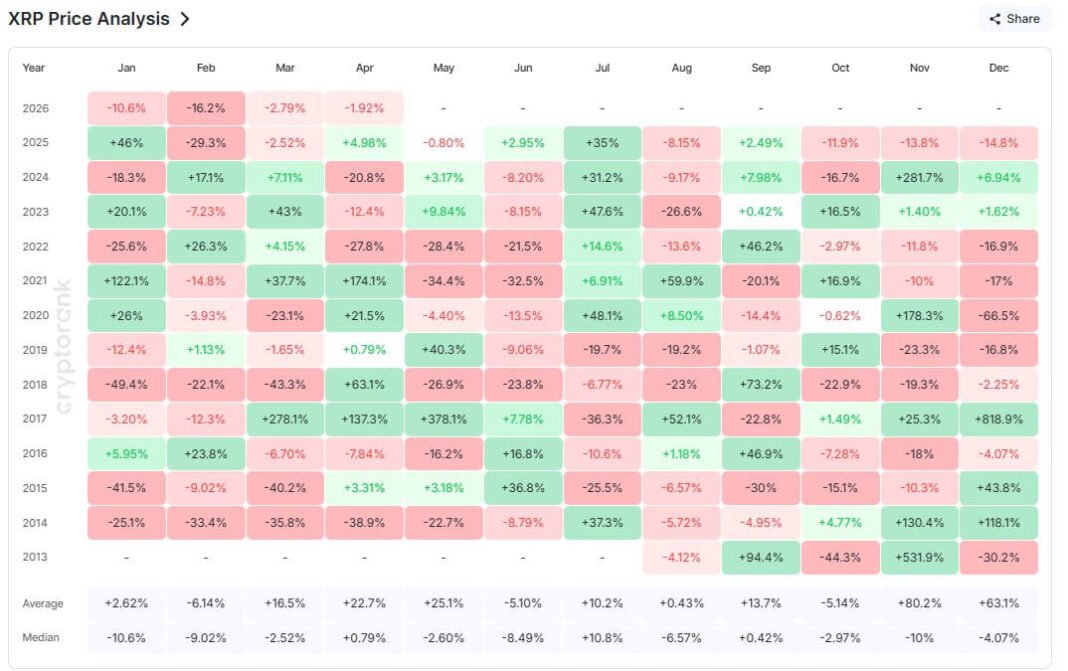
According to Cryptorank data, the token has fallen for six straight months since October 2025, losing an average of about 10% each month and shedding more than 55% over that period, trading at $1.33 as of press time.
This represents the longest stretch of monthly declines for XRP since a seven-month skid from December 2013 through June 2014, when it lost an average of 27% per month.
Meanwhile, the current downturn has come during a broader risk-off period across digital assets. Bitcoin has retreated from a peak above $126,000 to around $66,000, dragging sentiment lower across the market and leaving traders less willing to chase assets that lack a clear near-term driver.
For XRP, the weakness has been compounded by softer market activity. Data from CryptoQuant showed the token’s 30-day liquidity index on Binance fell to about 0.062, one of the lowest readings in recent periods, while the 30-day turnover index stood at about $4.46 billion.
Together, those figures point to thinner order books, lighter participation, and a market that is more vulnerable to sharp price swings when larger trades hit.
That backdrop helps explain why Ripple’s latest corporate and institutional advances are drawing renewed attention.
The company is expanding quickly across treasury management, prime brokerage, payments, and tokenized financial infrastructure, and the question facing the market is whether those gains can eventually translate into stronger demand, deeper liquidity, and a firmer narrative for XRP.
XRP enters corporate treasury workflows
Ripple’s latest move is to place digital assets directly within the software used by corporate finance teams, an area long dominated by fiat-only systems.
On April 1, the company introduced Digital Asset Accounts and Unified Treasury inside GTreasury, the enterprise treasury management platform it acquired in 2025.
The system processed $13 trillion in payments volume last year for clients ranging from small businesses to Fortune 500 companies, giving Ripple an established corporate channel rather than a new one built from scratch.
Digital Asset Accounts allow treasury teams to hold, view, and manage XRP, RLUSD stablecoin, and other supported tokens alongside traditional cash balances inside the same platform.
According to the firm, positions are shown with live fiat valuations, while transactions are recorded automatically with native token amounts, fiat equivalents, and the market price at the time of each event.
Ripple said the system also captures balances to 15 decimal places, aligning internal records more closely with on-chain activity.
On the other hand, unified Treasury extends that approach by linking digital asset holdings from multiple custodians through the same API layer already used for bank connectivity.
For finance teams, this promises a way to bring digital assets into existing approval, reporting, and compliance processes without forcing a separate operational setup.
Renaat Ver Eecke, senior vice president at Ripple Treasury, said the additions give the office of the CFO “a trusted, single place to hold and manage both digital and fiat assets.” He added that Ripple plans to connect that setup to its payments network and prime brokerage capabilities for cross-border settlement and yield generation.
The timing is notable. Ripple’s 2026 survey of more than 1,000 global finance leaders found that 72% said they need a digital asset solution to remain competitive, but many still lack a practical way to integrate that exposure into treasury operations.
By placing XRP within a system used by the CFO’s office, Ripple is trying to make the token part of routine corporate finance infrastructure rather than a stand-alone crypto allocation.
Ripple expands its market stack with Hyperliquid
Meanwhile, Ripple is also widening its footprint in institutional trading, a second front that could help strengthen the network around XRP even if the effect on the token is not immediate.
Ripple Prime, the company’s institutional trading platform, extended its HyperliquidX integration to include HIP-3 assets, opening access to on-chain perpetual contracts tied to traditional assets such as gold, silver, and oil.
The offering gives institutional clients exposure to decentralized derivatives through a framework that sits alongside more familiar portfolio and collateral management tools.
The pitch is operational simplicity. Institutions can manage these positions without handling separate Web3 wallets, fragmented collateral pools, or direct smart contract interaction.
Notably, Ripple Prime initially integrated with Hyperliquid in February 2026, becoming the sole counterparty for clients seeking access to the venue’s on-chain crypto liquidity.
That integration comes as Hyperliquid has grown into the largest decentralized perpetuals platform, with more than $5 billion in open interest and monthly trading volume that regularly exceeds $200 billion.
Data from ASXN shows that HIP-3 daily volume has topped $2 billion, with open interest at $2 billion, and that only seven of Hyperliquid’s top 30 markets are crypto pairs.
Against this backdrop, those steps suggest Ripple is building a broader trading and brokerage stack around digital assets, one designed to appeal to clients who want regulated access to blockchain-based markets without abandoning traditional portfolio structures.
Payments, stablecoins, and permissioned finance
The third leg of Ripple’s expansion is payments, where the company is increasingly tying together RLUSD, XRPL, and its enterprise network.
Ripple Labs and Convera said this week they will work together to improve global payments using stablecoin and blockchain infrastructure. Convera, formerly Western Union Business Solutions, operates across about 200 countries and territories and supports more than 140 currencies.
The partnership is centered on a “stablecoin sandwich” model in which transactions begin and end in fiat, while stablecoins are used in the middle of the payment flow.
That model fits Ripple’s broader strategy as stablecoins move deeper into mainstream finance. Stablecoins processed $33 trillion in volume last year, up 72% from 2024, but only a small share of that activity has so far been tied to practical payment functions such as payroll, treasury transfers, and remittances.
Ripple is also extending that strategy into public-private financial infrastructure. Last week, the company joined the Monetary Authority of Singapore’s BLOOM initiative to test programmable cross-border trade settlement using the XRP Ledger (XRPL) and RLUSD.
At the same time, XRPL is being adapted for more regulated institutional use through permissioned domains and a permissioned decentralized exchange, tools designed to create controlled venues where access can be limited through credentials and compliance checks.
The common thread is clear. Ripple is trying to position XRPL and its stablecoin infrastructure as part of a regulated operating layer for moving money, managing liquidity, and settling value across borders.
Can Ripple’s momentum lift XRP?
That still leaves the central market question unanswered. Ripple’s business is broadening, but XRP remains under pressure.
The token’s weak liquidity and lower turnover suggest that market participants have yet to treat Ripple’s expansion as a decisive reason to reprice XRP higher.
In part, that reflects the distinction investors continue to make between Ripple’s enterprise progress and the token’s direct utility. Treasury integration, brokerage services, and stablecoin partnerships can strengthen the company’s strategic position without immediately changing spot demand for XRP.
Even so, the longer-term case is that these efforts could deepen the conditions XRP needs to recover. More treasury usage can increase familiarity with the asset inside corporate finance. Broader institutional access can improve market structure. Greater use of XRPL and RLUSD in payments and settlement can reinforce the network’s relevance at a time when tokenized money movement is becoming more competitive.
Bitrue Research argued that XRP is expanding beyond its legacy payments identity into a broader stack that includes stablecoins, decentralized finance, sidechains, and cross-chain settlement.
The firm outlined a base case that could see XRP rise to $2.00 by September, with a stronger scenario of $2.50 if RLUSD adoption accelerates, XRPFi expands, and regulation becomes more supportive.
For now, those targets remain a forward bet rather than a confirmed shift. XRP is still in its deepest losing run in more than a decade.
However, as Ripple pushes deeper into treasury management, institutional trading, and regulated payment infrastructure, the market is being forced to consider whether the company’s gains can eventually become the token’s turning point.