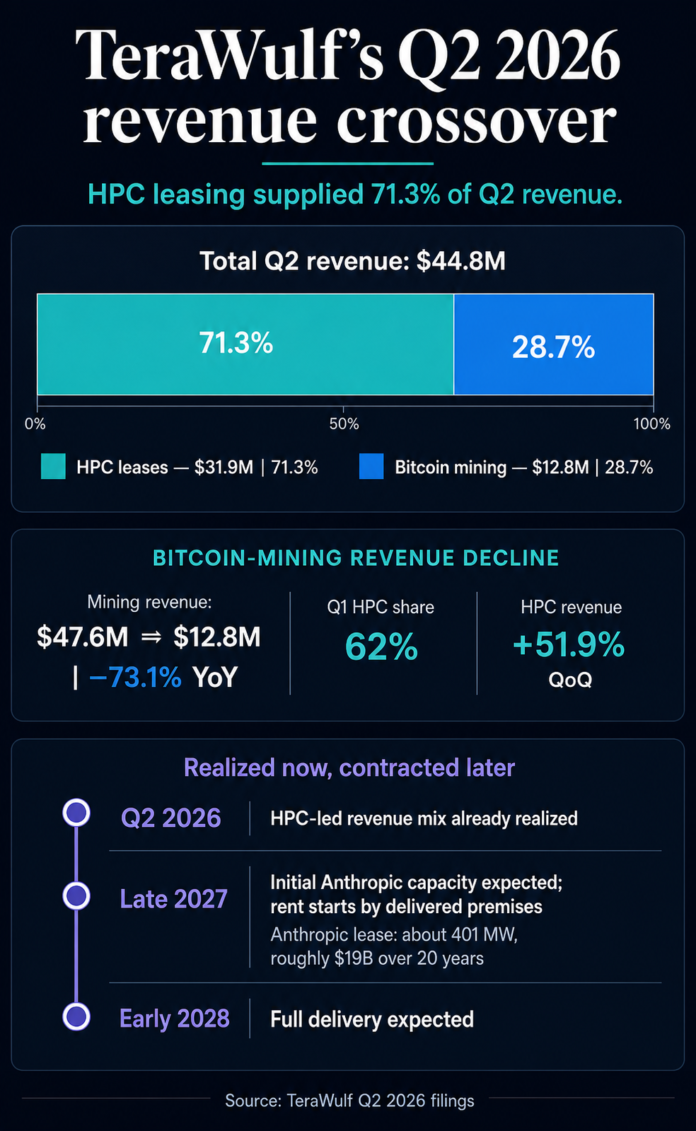
TeraWulf’s Bitcoin-mining revenue fell 73% year over year in the second quarter as high-performance computing and artificial intelligence leases reached 71% of sales, accelerating the company’s shift away from its original business.
According to the firm’s second-quarter report, digital asset revenue dropped to $12.8 million from $47.6 million a year earlier. On the other hand, HPC leasing generated $31.9 million, lifting total quarterly revenue to $44.8 million.
This means that the new business softened the mining collapse but did not fully replace it, leaving overall sales about 6% lower than a year earlier.
Still, the reversal reflects how rapidly the company has redirected its power and infrastructure toward data centers built for artificial intelligence workloads.
TeraWulf still operates Bitcoin-mining infrastructure at its Lake Mariner campus in New York, although portions are being repurposed for contracted HPC development. That shift has reduced mining to a secondary business as long-term data-center leases become the company’s principal revenue source.
Chief Financial Officer Patrick Fleury described the quarter as another step in the “transformation of our financial profile,” pointing to HPC’s 71% revenue share and stronger credit support behind the company’s leases.
TeraWulf spends heavily on AI to replace its Bitcoin mining engine
Building the infrastructure behind that AI transition has produced substantial losses and capital demands.
TeraWulf reported a $940.8 million net loss during the second quarter, largely driven by a $755.7 million noncash charge tied to the remeasurement of warrant liabilities. The firm’s net loss stands at approximately $1.4 billion this year.
The company nevertheless reported progress in converting construction into paying capacity. Lake Mariner had 81 megawatts of revenue-generating critical IT capacity at the end of June before an early-July delivery increased the total to 102 MW.
That delivery also activated $600 million of Google credit support for Fluidstack’s lease obligations. Another 336 MW remains under construction, with the first additional capacity expected to begin generating rent during the second half of 2026.
Chairman and CEO Paul Prager said these efforts showed that the company was “moving from platform formation to scaled execution.”
Prager argued that the firm’s control of power infrastructure would become more valuable as electricity access constrains AI development. He said:
“We are prepared to realize value where appropriate and redeploy capital toward larger-scale opportunities where we have greater control over the infrastructure, customer relationship and long-term economics.”
The largest test of these moves sits beyond the current buildout. TeraWulf signed a 20-year lease after quarter-end to provide Anthropic with about 401 MW at its Justified campus in Kentucky.
The agreement carries about $19 billion of contracted revenue, but initial capacity is not expected until the second half of 2027, with full delivery scheduled for early 2028. The firm added that revenue from this deal could rise to approximately $33 billion if Anthropic exercises both five-year extension options.
Despite the cost of its AI expansion, TeraWulf maintained its goal of contracting an additional 250 MW to 500 MW of critical IT capacity each year.
The company said it would pursue new projects selectively, focusing on sites with secured power, confirmed customer demand, scalable infrastructure and compelling risk-adjusted returns.