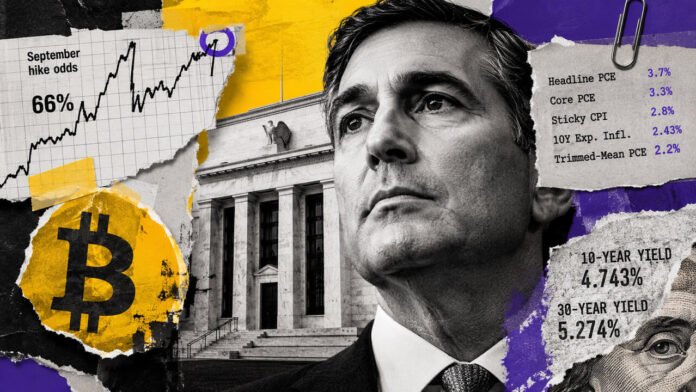
Bitcoin is trading near $63,000, with rate markets assigning roughly 66% odds to a September Federal Reserve hike, under a policy framework Kevin Warsh has left partly hidden.
The Fed chair has defined his reaction function around “underlying inflation,” then declined to disclose how he weighs the indicators that produce that judgment.
The official dashboard spans 1.5 percentage points: headline PCE runs at 3.7%, core PCE at 3.3%, the Atlanta Fed’s sticky-price CPI at 2.8%, Cleveland Fed 10-year expected inflation at 2.43%, and the Dallas Fed’s trimmed-mean PCE at 2.2%.
One economy supplies readings from nearly twice the Fed’s 2% goal to barely above it.
| Inflation measure | Latest reading | Gap from 2% target | What it tells Warsh |
|---|---|---|---|
| Headline PCE | 3.7% | +1.7 pp | Inflation still far above target |
| Core PCE | 3.3% | +1.3 pp | Underlying pressure remains elevated |
| Atlanta Fed sticky-price CPI | 2.8% | +0.8 pp | Persistent inflation is cooling, but not at target |
| Cleveland Fed 10-year expected inflation | 2.43% | +0.43 pp | Long-term expectations remain contained |
| Dallas Fed trimmed-mean PCE | 2.2% | +0.2 pp | Broad inflation is close to target |
Warsh told reporters that the Fed’s January strategy document keeps PCE as its formal objective. He invoked Goodhart’s Law, said the central bank could revisit its strategy in January 2027, and described a broader data project that aims to “separate the noise from the signal.”
His operative judgment can therefore come from a wider set of inputs than the measure the formal framework identifies.
That distinction leaves Bitcoin traders pricing two unknowns at once: the next inflation readings and the weight Warsh assigns each one. A 3.7% headline figure supports tighter policy, and a 2.2% trimmed mean gives the Fed room to wait when long-term expected inflation sits near 2.43%.
The Fed is rebuilding its inflation lens
The Federal Reserve created five monetary-policy task forces on July 9. Raj Chetty, Doug McMillon, and Kevin Murphy head its Data Sources group, which will seek timelier economic information.
A separate Inflation Frameworks group will reconsider how the central bank interprets the drivers of inflation.
Warsh plans to review the groups’ work before Jackson Hole, and he left open the possibility that their early findings could shape his August speech. The next hard policy deadline arrives Sept. 15-16, when the FOMC meets with a new Summary of Economic Projections.
January 2027 then offers the first formal opening for a revised strategy statement.
The FOMC kept its target range at 3.50% to 3.75% through a 9-3 vote, with Beth Hammack, Neel Kashkari and Lorie Logan supporting a quarter-point increase. September hike odds neared 65% on July 31, and the Atlanta Fed tracker had placed the probability at 83.05% on July 29, illustrating how quickly traders reprice the path.
The 10-year Treasury yield ended July near 4.743%, and the 30-year reached 5.274%, its highest level in 19 years. Subtracting Cleveland Fed 10-year expected inflation of 2.434% from the nominal 10-year yield produces a simple expected real rate near 2.31%.
That real return competes directly with Bitcoin, which offers zero cash yield. Higher real rates raise the opportunity cost of holding BTC, support the dollar, and reduce the balance sheet capacity available for risk assets.
Bitcoin’s move toward $63,000 has occurred inside that tighter liquidity setting.
US-traded spot Bitcoin funds took in $233.1 million on July 30, then recorded $87.9 million of net redemptions on July 31. Cumulative net inflows stand near $51.56 billion, giving Bitcoin an institutional demand channel whose daily support can still reverse.
| Date / marker | What happens | Bitcoin relevance |
|---|---|---|
| July 9 | Fed creates five monetary-policy task forces | Confirms Warsh is formally rebuilding the policy lens |
| July 29 | FOMC holds rates at 3.50%–3.75% in a 9-3 vote | Three dissents show September tightening risk is live |
| July 29 | Atlanta Fed tracker probability at 83.05% | Shows how aggressively traders can price a hike |
| July 31 | September hike odds near 65% | Shows rate pricing remains volatile |
| Late August | Jackson Hole | First possible clue on Warsh’s weighting system |
| Sept. 15–16 | FOMC meeting and new projections | First major rate decision after the data cycle |
| January 2027 | Possible revised Fed strategy statement | Formal opening for changes to the inflation framework |
When headline PCE sets policy
The bearish path starts with Warsh treating headline PCE at 3.7% and core PCE at 3.3% as the best evidence of generalized inflation.
Higher oil prices, firmer inflation expectations and continued economic resilience would reinforce that interpretation, giving the three July dissenters a stronger case for September.
Rate markets would push up hike odds, Treasury yields would stay firm, and the dollar would gain another source of support. Bitcoin would then face tighter financial conditions alongside mixed ETF flows, placing renewed stress on the $62,000 area.
A sustained loss of $62,000 would bring $60,000 into the immediate price map. The late-June zone near $58,000 enters only once sellers establish acceptance below $60,000. Confirmation would come from higher real yields, firmer breakevens, a stronger dollar and another round of ETF redemptions.
The lower inflation gauges would carry less policy weight under this path. Warsh could conclude that trimmed measures remove too much of the tariff and energy transmission entering household prices, leaving the 2.2% reading unable to justify patience.
The path through trimmed inflation
The bullish path requires Warsh to classify energy and other volatile categories as noise, giving greater weight to trimmed-mean PCE at 2.2%, sticky-price inflation at 2.8%, and 10-year expected inflation near 2.43%. Continued cooling across those measures would give the Fed room to hold in September.
Lower hike odds would ease real yields and weaken the dollar’s support, reopening liquidity for Bitcoin. BTC would first need to recover $64,500, then clear the Friday high near $65,300.
A clean move through that area would reopen $66,000 and $68,000.
| Scenario | Warsh’s inflation read | Macro reaction | Bitcoin confirmation | Price map |
|---|---|---|---|---|
| Bear case: headline PCE drives policy | 3.7% headline PCE and 3.3% core PCE are treated as the signal | Hike odds rise, yields stay firm, dollar strengthens | ETF redemptions resume, real yields rise, $62,000 fails | $60,000 comes next; $58,000 only after $60,000 breaks |
| Base case: dashboard stays unresolved | High headline inflation and low trimmed inflation both remain plausible | Rates and dollar swing with each Warsh comment | BTC fails to hold above $65,300 but does not lose $62,000 | Range between $62,000 and $65,300 |
| Bull case: trimmed inflation drives patience | 2.2% trimmed mean, 2.8% sticky CPI and 2.43% expectations carry more weight | Hike odds fall, real yields ease, dollar support weakens | ETF creations return, spot buying leads, BTC reclaims $64,500 then $65,300 | $66,000 and $68,000 reopen |
Spot-market buying, falling open interest during the rebound and renewed ETF creations would strengthen that case. Those conditions would tie the advance to spot demand and reduced hedging demand, giving Bitcoin a firmer foundation than a derivatives-led burst.
Jackson Hole may provide the first public clue about Warsh’s weighting system, and Sept. 16 carries the rate decision and fresh projections.
By then, markets may know every major inflation print and still lack the formula that converts those readings into policy, and Bitcoin is already trading that gap.