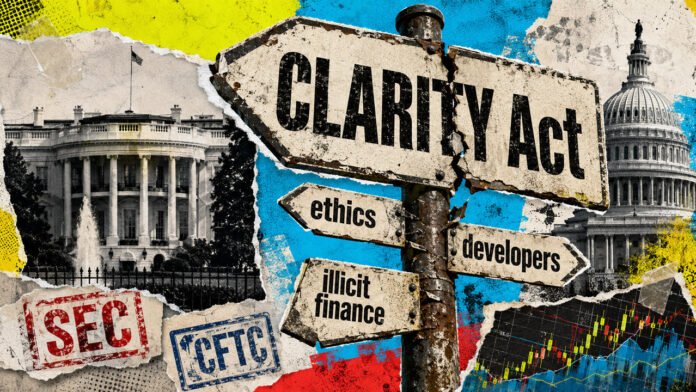
Senate negotiations over the landmark CLARITY Act are producing fresh concessions, but little evidence that the parties are moving closer to a deal.
Democrats are moving on regulatory appointments and ethics, while law-enforcement groups have proposed new language for one of the CLARITY Act’s most contentious provisions.
The White House and crypto advocates, however, have rejected some of those overtures in unusually blunt terms, leaving a bipartisan ethics counteroffer as the next major test of whether negotiators can still bridge their differences.
Democratic nominees narrow one CLARITY sticking point
Senate Minority Leader Chuck Schumer has sent the White House two potential candidates each for Democratic seats at the Securities and Exchange Commission (SEC) and Commodity Futures Trading Commission (CFTC), addressing a personnel dispute that had become increasingly entangled with CLARITY negotiations.
Semafor White House reporter Eleanor Mueller reported the submissions, citing people familiar with the move. The identities of the prospective nominees remain unclear as officials seek to shield them from political attacks before the administration decides whether to proceed.
“Nobody wants any of these nominees to get flamed before they get a fair chance,” one person familiar with the process told Semafor.
The move follows months of Democratic pressure over vacancies at financial regulators.
In June, 11 Senate Banking Committee Democrats urged the Trump administration to nominate Democrats to seats reserved for minority-party members, warning that the absence of opposition-party commissioners was eroding the bipartisan structure Congress intended for those agencies.
According to the lawmakers:
“No Democrats now serve in leadership roles at any agency within the Committee’s jurisdiction.”
The White House later pushed back, saying Senate Democrats had been asked to provide candidates for vacant SEC and CFTC seats but had yet to submit names.
Schumer’s move changes that dynamic.
President Donald Trump must still choose candidates and formally nominate them before the Senate can consider confirmation, but the administration now has names to evaluate, weakening one of its responses to Democratic complaints over the vacancies.
The issue has taken on greater significance because the CLARITY Act would give the SEC and CFTC major responsibility for implementing a new federal digital-asset framework. Democrats have argued that agencies receiving expanded authority should not write those rules without minority-party representation.
The White House, however, is treating Schumer’s submissions as political positioning rather than a meaningful breakthrough. Patrick Witt, executive director of the President’s Council of Advisors for Digital Assets, said:
“Let’s not kid ourselves. Chuck Schumer is doing the absolute bare minimum here to avoid Democrats being blamed if Clarity fails to pass. No one is fooled.”
The exchange moves the nominations dispute closer to resolution without easing the broader political tension, leaving negotiators to confront the more difficult fights over the substance of CLARITY itself.
Developer fight hardens as ethics talks gain ground
The harder substantive fight emerged this week after two groups representing prosecutors proposed changes to CLARITY’s protections for software developers, only to see the offer rejected by both sides of the negotiations.
The provision has become a major sticking point for Sen. Catherine Cortez Masto, a Nevada Democrat and former state attorney general, who has sought to preserve law-enforcement powers over illicit finance without treating developers who merely write software as financial intermediaries.
Cortez Masto voted against advancing an earlier version of CLARITY in May, warning that the language could impair authorities’ ability to trace illicit funds, recover assets for victims and prosecute people knowingly transmitting criminal proceeds.
She nevertheless said lawmakers should protect “everyday coders” who are not participating in those activities.
The prosecutors’ latest proposal offered a potential route through that dispute, but the White House rejected suggestions that it reflected meaningful progress in negotiations.
In an X statement, Witt said:
“Calling this the ‘culmination of productive negotiations’ with the White House and Treasury is like saying Maduro’s removal from Venezuela was the culmination of productive negotiations with the U.S. government. We have made our position abundantly clear to Senator Cortez-Masto for weeks. This is not even close.”
Meanwhile, crypto advocates have also rejected the proposal from the opposite direction.
Amanda Tuminelli, chief executive officer of the DeFi Education Fund, said the proposal would effectively treat software developers as financial intermediaries even when neither their role nor the underlying technology fits that description.
According to her:
“This is not a constructive or serious proposal from these groups, and it actually shows their hand. They want every software developer to be treated like a financial intermediary even when that isn’t what they are/the technology is doing.”
She said industry representatives had spent “countless hours” working with law-enforcement groups to address their concerns and clarify what CLARITY would and would not do.
“The response to that hard work appears to be an 11th-hour DOA ‘offer’ via press release,” Tuminelli said. “This is not what good faith looks like.”
The rejection from both directions leaves negotiators searching for language that preserves authorities used against illicit finance without imposing intermediary-style obligations on developers who do not control customer assets or transactions.
The ethics fight, however, is moving along a more bipartisan track.
Sens. Ruben Gallego, an Arizona Democrat, and Thom Tillis, a North Carolina Republican, are finalizing a counteroffer they plan to send to the White House within days, according to Politico.
The effort follows Democrats’ rejection of the ethics provisions in the latest Republican draft.
Gallego and six other Democratic negotiators said last week that the bill still needed stronger protections covering ethics, consumer protection, illicit finance, conflicts of interest and market integrity, while pledging to continue negotiating.
The Gallego-Tillis proposal could therefore provide a different test of the White House’s willingness to compromise: unlike the prosecutor language now drawing fire from both Washington and the crypto industry, the ethics counteroffer is being built by senators from both parties before it reaches the administration.
Whether it fares any better could help determine how much room remains for a broader CLARITY deal.