Robinhood’s crypto-related transaction revenue in the fourth quarter of 2024 generated $358 million of the company’s $672 million in transaction-based revenue, about 53% of the total.
That concentration had flipped by the second quarter of 2026, when crypto revenue fell 38% year over year to $100 million and accounted for just 12.9% of transaction-based revenue.
Options reached $342 million, event contracts brought in $156 million, and equities added $129 million, together producing 81% of the segment and six times what crypto contributed. Net interest revenue and other revenue, driven in part by Gold subscriptions, added $389 million and $143 million, respectively.
| Metric | Q4 2024 | Q2 2026 | What changed |
|---|---|---|---|
| Crypto transaction revenue | $358M | $100M | Down sharply |
| Total transaction-based revenue | $672M | $776M | Higher despite crypto decline |
| Crypto share of transaction revenue | 53.3% | 12.9% | Crypto no longer drives the segment |
| Options revenue | N/A | $342M | Largest trading line |
| Event contracts revenue | N/A | $156M | New major growth engine |
| Equities revenue | N/A | $129M | Larger than crypto |
| Non-crypto trading revenue listed | N/A | $627M | Roughly 6x crypto revenue |
Crypto’s new job in the stack
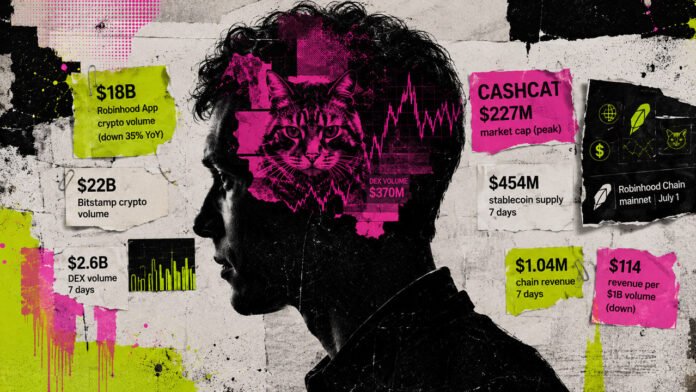
Robinhood reported $40 billion in total crypto notional volume for the quarter, and Bitstamp shows where most of it went. The Robinhood app supplied $18 billion of that, down 35% year over year, with Bitstamp now supplying the larger share at $22 billion.
That volume sits inside a wider structure Robinhood has been assembling: Bitstamp for institutional liquidity and international reach, Robinhood Wallet for self-custodial access to on-chain products, and Robinhood Chain for settlement and programmability.
Stock tokens bring equities onto those same rails, and Earn and perpetuals add lending and derivatives on top. The original Robinhood app still anchors the structure, with nearly 30 million investment accounts.
With that structure in place, Robinhood now earns across a broader financial business that runs partly on crypto rails.
Institutional exchange volume, the kind Bitstamp brings, can carry a lower monetization rate than retail app trading. Crypto revenue in the fourth quarter of 2024 amounted to roughly $5 million per $1 billion in notional volume.
By the second quarter of 2026, that figure had fallen to about $2.5 million per $1 billion. That gap points to Bitstamp adding reach and infrastructure well before it adds comparable revenue.
| Layer | Robinhood asset/product | Role in the stack | Revenue or value-capture question |
|---|---|---|---|
| Retail trading | Robinhood app | Original crypto trading venue | Can app crypto volume recover? |
| Institutional exchange | Bitstamp | Global liquidity and non-US reach | Does volume convert into meaningful revenue? |
| Self-custody | Robinhood Wallet | Gateway to on-chain products | Do wallet users become active financial users? |
| Settlement layer | Robinhood Chain | Programmability for tokenized finance | Does chain activity create durable fees? |
| Tokenized assets | Stock tokens | Equities on crypto rails | Can RWA activity outgrow memecoin activity? |
| Yield | Earn | Lending and collateral markets | Can lending assets scale without risk events? |
| Derivatives | Perpetuals | Advanced international trading | Does derivatives volume become recurring revenue? |
| Subscription | Robinhood Gold | Cross-sell and retention layer | Do crypto/on-chain users convert to Gold? |
The memecoin run inside the infrastructure story
Robinhood Chain went live as a public mainnet on July 1, an Arbitrum-based layer-2 network designed for tokenized stocks, real-world assets (RWA), DeFi lending, and AI-native finance. The first major burst of activity came from something else entirely.
CASHCAT, a memecoin tied to Robinhood’s old “CashCat” origin story, reached over $227 million in market cap and sparked a run of memecoins inside Robinhood Chain.
A Dune dashboard shows that spot DEX volume on Robinhood Chain reached nearly $370 million on July 29, driven mainly by memecoins.
On the same day, token deployments across multiple launchpads surpassed 29,000 entries, with Pons accounting for 14,751 launches.
That memecoin trading generated real activity: Robinhood Chain handled over $2.6 billion in decentralized exchange volume over seven days.
DefiLlama shows that stablecoin supply on the network surpassed $500 million over the same period, and Chain revenue topped $1 million over the past seven days.
CASHCAT’s market value of $45 million, even after an 80% drawdown from its price peak, is over 60% larger than the nearly $28 million in tokenized RWA market cap on the network.
The chain as the real test
Stock tokens trade on Robinhood Wallet in more than 120 countries, are available 24 hours a day, and can be used as collateral in DeFi lending pools.
Robinhood describes them as tokenized debt securities that provide economic exposure to the underlying shares, without conferring legal or beneficial ownership. They are also unavailable in the US and restricted in several other jurisdictions.
The mix of stock-token holders, lending assets, memecoins, and recurring DEX volume will show what kind of activity the network can sustain after the initial rush fades.
Robinhood now has trading volume flowing through both its apps and its chain, creating a valuation challenge.
In the bull case, Robinhood’s next quarterly earnings report begins to reflect the full stack built on Robinhood Chain, including the memecoin rush, stock tokens, stablecoins, Earn, and perpetuals.
| Signal to watch | Bull-case reading | Bear-case reading |
|---|---|---|
| DEX volume | Sustained activity creates chain revenue | Launch-week memecoin churn fades |
| Memecoin share of volume | Useful cold-start liquidity | Low-quality speculative activity dominates |
| CASHCAT market cap | Brand-native liquidity anchor | Single-token concentration risk |
| Token deployments | Developer and launchpad activity | Spam, scams, and short-lived launches |
| Stablecoin supply | Sticky liquidity base | Mercenary liquidity leaves |
| RWA / stock-token market cap | Tokenized finance thesis gaining traction | RWA adoption remains thin |
| Earn lending assets | Recurring yield and fee stream | Smart-contract and liquidity-risk exposure |
| Chain revenue | Infrastructure monetization | Too small or volatile for earnings multiple |
| Gold subscriber conversion | Chain supports wider Robinhood ecosystem | On-chain users stay outside core app economics |
In that scenario, RWA market cap would climb, stock-token volume would grow, stablecoin supply would hold, memecoin activity would remain solid, and chain revenue would persist. Gold subscriptions, which grew 39% year over year to 4.8 million this quarter, would provide another supporting signal. Investors would start pricing Robinhood Chain as credible, durable infrastructure.
In the bear case, the memecoin mania fades too sharply, DEX volume drops, and RWA adoption stays thin. CASHCAT-style tokens collapse, launchpad deployments fall, stablecoin supply leaves the network, and chain revenue declines with it. Investors would file Robinhood Chain away as a brief attention spike after launch.
Robinhood’s record quarter was driven by options, event contracts, and equities, with crypto trading now a minor line item.
Robinhood Chain shows that the infrastructure Robinhood designed for tokenized finance is capturing attention and revenue, making it trickier to assess the role crypto plays in the firm’s earnings.