
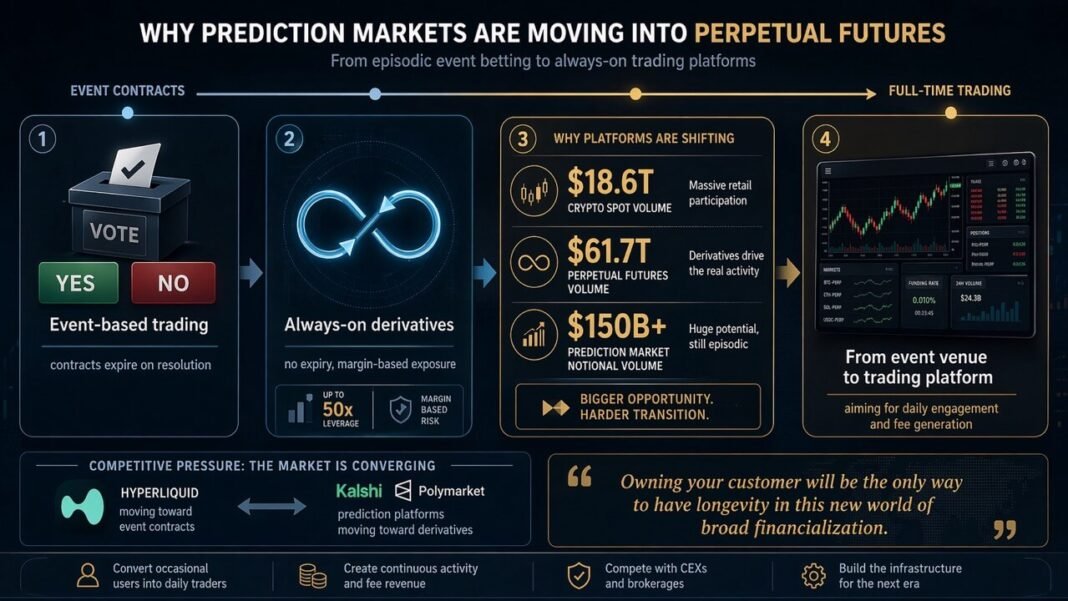

Top prediction market platforms, including Kalshi and Polymarket, are rushing to offer highly leveraged crypto derivatives at the exact moment state and federal authorities are clashing in court over whether the industry’s core products constitute illegal betting or legitimate financial instruments.
Over the past year, these companies have gained national prominence by facilitating wagers on discrete, real-world occurrences, ranging from political races to macroeconomic data releases.
Now, by preparing to list perpetual futures, which are complex contracts that never expire and allow traders to multiply their market exposure using borrowed funds, these platforms are blurring the line between niche forecasting hubs and full-service digital asset exchanges.
Against this backdrop, this shift drastically expands their potential customer base, but it also amplifies the legal risks associated with the platforms.
Perpetuals push prediction venues toward full-time trading
Historically, platforms like Kalshi operated on a cyclical, event-driven basis, with traffic and trading volume spiking around major catalysts such as a presidential debate or a championship sporting event and then plummeting once the outcome was settled.
In this kind of market, a user purchased a binary “Yes” or “No” share, and the contract expired upon the event’s resolution.
Perpetual futures fundamentally alter that business model. Because these derivatives lack an expiration date, participants can maintain their market positions indefinitely, provided they meet ongoing margin requirements.
The instruments frequently allow users to leverage their bets up to 50 times their initial capital, attracting aggressive speculators seeking rapid returns from minute price fluctuations.
By rolling out these derivatives, Polymarket and Kalshi are abandoning their siloed event-contract operations to compete directly with centralized exchanges and retail brokerages. The underlying strategy for both platforms is to convert occasional political bettors into daily, high-frequency traders.
While Kalshi has explicitly stated its intention to enter the perpetuals arena, Polymarket’s exact roadmap remains guarded, including which specific assets it will cover and whether it will restrict access for US customers.
Why perps, why now?
The motivation to embrace this new feature comes down to basic market structure.
Traditional crypto spot trading, which is the simple buying and holding of digital assets, has decelerated from the frenzied peaks of previous market cycles, logging $18.6 trillion in volume last year.
Meanwhile, perpetual futures generated more than three times that amount. Data from CryptoQuant show that the global trading volume for crypto perpetual futures hit $61.7 trillion last year.
That volume disparity dictates corporate strategy. Platforms recognize that to maintain engagement during periods of low volatility, they must offer instruments that allow users to short the market, hedge portfolios, and employ leverage.
While prediction markets currently command significant capital, with all-time notional volume surpassing $150 billion, the episodic nature of event contracts cannot match the continuous, around-the-clock fee generation of a highly active derivatives order book.
Moreover, the broader financial technology sector is experiencing a rapid collapse of operational boundaries, with centralized platforms like Robinhood, Coinbase, and Gemini all embracing event-based offerings.
Mo Shaikh, co-founder of the Aptos blockchain network, noted that financial applications have historically trended toward consolidation, citing the expansions of legacy platforms like PayPal. However, he warned that forcing disparate user bases into a single application rarely succeeds seamlessly.
“The trader, the bettor, the long-term investor, the payments user, they show up for different reasons,” Shaikh said, adding that true value lies in controlling the underlying infrastructure. “Clearing, liquidity, identity, settlement, data, those layers can unify even if the frontends remain fragmented.”
Meanwhile, the shift among prediction market players is partially defensive.
Offshore decentralized exchange Hyperliquid, a dominant force in perpetual futures, recently encroached on the prediction sector by revealing plans to list its own event contracts.
As a result, the market is split on who holds the strategic advantage in the ensuing turf war.
Jiani Chen, a growth officer with the Solana Foundation, noted the technical disparities, arguing that decentralized derivatives exchanges have a much easier time adding prediction markets to their backend than prediction platforms do spinning up complex futures trading engines.
However, Kyle Samani, chairman of Forward Industries, dismissed the technical hurdles, arguing that customer acquisition is the true bottleneck for digital asset platforms. He said:
“It’s way harder to bootstrap liquidity and acquire normie users for prediction markets. Kalshi perps are going to crush.”
The legal fight is still about who gets to call it gambling
The aggressive product expansion coincides with an existential legal threat as state regulators are launching coordinated efforts to classify the prediction platforms as unlicensed casinos, rejecting the premise that event contracts are sophisticated financial tools.
On April 21, New York Attorney General Letitia James filed sweeping lawsuits against digital asset firms Coinbase and Gemini, demanding $3.4 billion in combined penalties and restitution.
James alleged the companies bypass state taxes and consumer protection laws by offering prediction markets to retail users, including minors.
State officials pointed to research by the National Institutes of Health linking early exposure to mobile betting with heightened risks of anxiety and financial distress, while noting American Psychological Association data showing severe mental health risks associated with gambling disorders.
James said:
“Gambling by another name is still gambling, and it is not exempt from regulation under our state laws and Constitution.”
The industry firmly rejects the gambling label, countering that the contracts are vital instruments for hedging geopolitical and economic risks.
The CFTC has backed this interpretation by asserting exclusive federal jurisdiction over the sector. In a bid to block state-level interference, the federal agency recently filed lawsuits against authorities in Arizona, Connecticut, and Illinois.
The judiciary is already untangling the overlapping claims. A federal appeals court in Philadelphia ruled against New Jersey gaming regulators earlier this year, determining the CFTC held sole regulatory authority over Kalshi’s election and sports-related contracts.
This sequence of litigation reflects a deeply fractured regulatory perimeter that companies must navigate as they deploy new derivative products.
A bigger market, and a bigger regulatory target
The move into perpetual futures would further position prediction markets as part of mainstream financial infrastructure rather than a niche corner of online speculation.
That shift is already drawing attention from traditional finance. The Intercontinental Exchange, parent of the New York Stock Exchange, recently invested $2 billion in Polymarket, a sign that major market operators see commercial value in platforms built around event-driven pricing.
Supporters of the model argue that prediction markets are proving useful as both forecasting tools and trading venues.
In high-liquidity markets, Brier scores, a standard measure of probabilistic accuracy, have fallen as low as 0.0247 shortly before resolution, suggesting pricing errors narrow sharply as capital and participation deepen. Industry estimates also show that about 10% of proprietary trading firms are already active in event contracts, using them in part to hedge macro and policy risk.
That combination of data value and trading activity helps explain why platforms are racing to broaden their product mix.
Rob Hadick, managing partner at Dragonfly, framed the commercial logic bluntly:
“Owning your customer will be the only way to have longevity in this new world of broad financialization.”
However, not everyone sees perpetual futures as the natural next step.
Alex Momot, chief executive and co-founder of Peanut Trade, told CryptoSlate that the current push looks more like a response to tightening legal pressure than a durable product strategy.
He noted that regulators and some jurisdictions are moving against prediction markets, and as a result, these operators appear to be shifting closer to the crypto-exchange model, where the rules are clearer, and the risk of being classified as gambling is lower.
Momot argued that strategy may offer only limited relief. In his view, the deeper problem is liquidity. Without more depth, many of the sector’s most promising use cases, including hedging and insurance against real-world event risk, remain too small to scale.
He said the stronger long-term path may lie in index-style products, market aggregation, and pooled liquidity across events, structures that could make prediction markets look more like traditional derivatives or synthetic exposures.
That viewpoint points to a broader tension now shaping the industry. One camp sees perpetual futures as the fastest way to capture more trading volume and keep users active between headline-driven events. Another sees them as a tactical detour from the harder task of building deeper, more resilient liquidity.
Either way, the legal risk is rising. Dyma Budorin, founder and chief executive of CORE3, said the merging of prediction and derivatives markets is likely to draw closer scrutiny from regulators already struggling to define the sector.
He said:
“What we’re really seeing is a convergence toward perp-like behavior without the corresponding risk controls. If this trend continues, regulators won’t treat prediction markets as harmless forecasting tools, they’ll treat them as derivatives platforms operating outside the rules. And historically, that doesn’t end quietly.”
The New York litigation has already ensured that the fight over jurisdiction will remain central to the industry’s future. That battle could eventually reach the U.S. Supreme Court or force Congress to step in with a clearer statutory framework.
Until then, prediction-market operators appear willing to keep expanding through the uncertainty, betting that the commercial upside of perpetual futures is worth the legal exposure.