
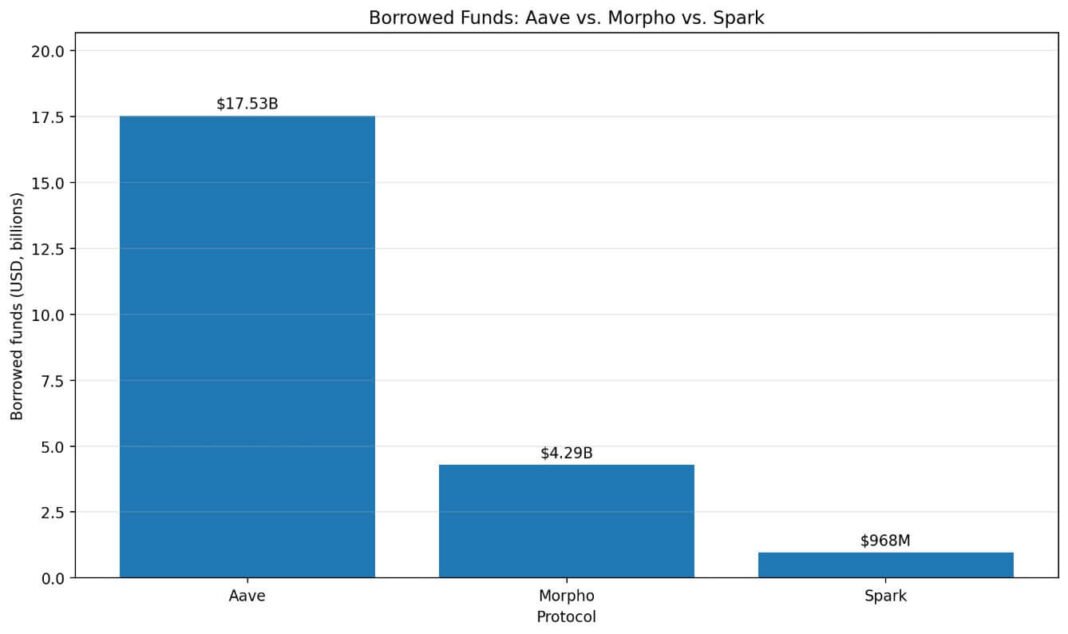

Aave commands DeFi lending, with DefiLlama showing $24.51 billion in total value locked and $17.526 billion in borrowed funds.
The margin against Morpho, its closest rival, is roughly 4.1 times. Spark, the third-largest competitor, sits at $967.52 million in borrowed funds.
Aave ended 2025 with 61.5% active loan market share and 52.4% lending TVL share, according to its own accounting. Over less than two months, three of the most visible independent contributor teams tied to Aave’s code, governance, and risk management either announced departures or began winding down.
BGD Labs said on Feb. 20 it would cease contributing because “the environment no longer aligns,” with off-boarding beginning by Apr. 1. ACI said on Mar. 3 it would not renew and would wind down over four months.
Chaos Labs said on Apr. 6 it was ending its engagement on its own terms, having managed risk across Aave V2 and V3 since November 2022.
Aave’s governance documents describe an operating chain in which ACI handled growth, Chaos Labs handled risk, and BGD handled technical and security verification. LlamaRisk and the Protocol Guardian serve as risk guardians.
ACI itself wrote that every major initiative required the full service-provider chain.
Three exits in sequence form a pattern that hits the protocol’s documented operating model at the same juncture.
A configuration error made the governance fight real
On Mar. 10, a CAPO oracle misconfiguration pushed the effective wstETH exchange rate roughly 2.85% below market.
That deviation triggered approximately $10.938 million in wstETH liquidations across 34 accounts, generating about $26.6 million in liquidation volume. Aave’s post-mortem confirms no bad debt, but a reimbursement proposal of 512.19 ETH.
As a result, the move would cost the DAO 358.56 ETH, putting the event well past the threshold of a governance footnote.
Chaos Labs cited the V3-to-V4 transition as a key reason its exit creates a genuine operational burden. Aave has V4 live on the Ethereum mainnet with three liquidity hubs and deliberately conservative caps, while V3 stays active.
Chaos argued in its exit that managing a live overlap between a battle-tested version and a new hub-and-spoke architecture requires materially more risk tooling and staffing, estimating a minimum risk budget of $8 million, versus its historical $3 million engagement and Aave’s roughly $142 million 2025 revenue base.
The oracle event lends that argument specific weight: even a configuration-layer error caused eight-figure harm to users.
What Aave Labs is absorbing
Aave Labs is moving quickly to absorb the gap. Its “Aave Will Win” ARFC proposes that Labs take on governance tooling, DAO GitHub maintenance, Guardian coordination, CAPO pricing management, bridge adapter maintenance, governance technical reviews, and much of the proposal lifecycle and incentive infrastructure previously tied to BGD and ACI.
The Labs’ consolidation argument is that the protocol should not depend on any single external shop.
V4 underwent approximately 345 cumulative days of security review, involved four audit firms plus independent researchers, and the public contest and published reports surfaced no critical or high findings.
Aave also carries over $250 million in Umbrella first-loss coverage. BGD, though departing from its lead contributor role, has proposed a two-month advisory retainer through May 31, keeping it in a narrower security-focused capacity in the near term.
LlamaRisk keeps its Aave engagement, and the new risk-agent architecture assigns Risk Guardian responsibilities to LlamaRisk and the Protocol Guardian.
The pro-consolidation logic runs like this: a smaller, well-defined set of accountabilities under Labs means faster execution and cleaner lines of responsibility. That argument works best if Labs can execute without a second operational incident during the V3/V4 overlap.
| Function | Previous lead | Current / proposed replacement | Why it matters |
|---|---|---|---|
| Growth / governance coordination | ACI | Aave Labs absorbing parts | Proposal flow, ecosystem coordination |
| Risk management | Chaos Labs | LlamaRisk / Protocol Guardian / Labs transition | Parameter setting, monitoring, incident prevention |
| Technical / security verification | BGD | Aave Labs + BGD advisory retainer through May 31 | Implementation review, security checks |
| CAPO pricing / governance tooling / GitHub / bridge maintenance | BGD + ACI linked workflow | Aave Labs | Operational continuity during V3/V4 overlap |
The bullish outcome
If the consolidation works, Aave holds or extends its DeFi lending share in a market that Token Terminal sized at $27.68 billion in active loans as of March, where Aave held 59.79%.
The path runs through smooth V4 cap raises, no second-control incidents, continued GHO growth, and traction from Aave Pro, Horizon, the Aave App, and its MiCA-authorized fiat ramp via Push.
Integrations, developer tooling, liquidity depth, and the sheer breadth of collateral accepted make switching costs real for large borrowers.
February’s market correction showed what that resilience looks like in practice: Token Terminal’s February report showed Aave handled approximately $429 million in liquidations across 12,500 transactions and $1.7 billion in stablecoin outflows without incident.
The protocol processed stress without breaking. A governance transition, even a messy one, leaves that operational record intact.
Aave is also moving beyond its lending app branding. It holds more than 80% of USDT and USDC deposits and borrows on Ethereum, with roughly $20 billion in stablecoin deposits and $13 billion in borrowed funds.
At that scale, Aave functions more like a credit infrastructure for on-chain dollar markets. Holding that position gives it a durability argument independent of any single contributor’s departure.
The bearish scenario
The departing teams collectively built the operating layer that connects risk models to production.
Chaos priced every loan on Aave since November 2022 with zero material bad debt. BGD maintained the technical architecture and security review chain. ACI handled governance flow and growth coordination.
Labs is absorbing the operational texture of how those functions interact when a parameter update, a market move, and a governance proposal land simultaneously.
The March CAPO event ran through precisely that intersection. A configuration-layer decision that passed through the existing operating model still resulted in a 2.85% deviation, costing users eight figures.
Chaos Labs argues that V4 increases the surface area for that kind of error, and that the risk budget Aave historically allocated to external management falls far short of what that surface area requires.
If Labs cannot replicate the operational density of the old federated model, consisting of governance execution, parameter oversight, security maintenance, and incident response running in parallel, Morpho and Spark gain a narrative advantage on execution alone.
Morpho now holds $7.337 billion in TVL and $4.29 billion in borrowed funds, and it has structured its expansion around a modular, market-specific architecture that differs from Aave’s unified liquidity model.
The current 4:1 borrowing gap is large, but slow premium leakage works through compounding capital choices.
New capital only needs to consistently choose a cleaner-looking alternative over a protocol managing a visible governance transition.
GHO, Horizon, and Aave Pro give the protocol more surface area to win on, while also meaning that Aave is expanding its ambitions exactly as its contributor bench gets thinner.
If a V4 incident occurs before Labs has demonstrated it can run the full operating chain, the contributor narrative crosses from governance-era transition into a confidence-pricing event.