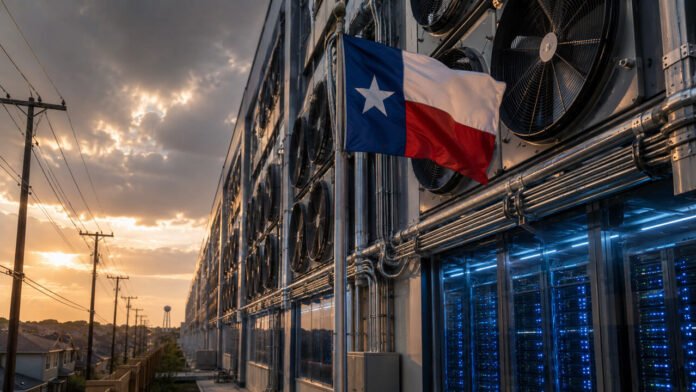
Texas spent years courting AI companies, cloud providers, and Bitcoin miners with cheap electricity, abundant land, and a sales tax exemption that’s grown into one of the state’s costliest incentive programs.
But now, Governor Greg Abbott has told state regulators to flip the arrangement, directing them to require data centers to fund the grid they depend on, so households would “stop subsidizing one of the fastest-growing industries in the world.”
That rather sudden change in sentiment could become the template for how the rest of America regulates the AI buildout.
The state spent the better part of the last decade making itself the easiest place in America to build a data center, and the bill for that hospitality seems to have come due.
Texas now has roughly 6.5 gigawatts of capacity under construction, about a fifth of the national pipeline, and the real estate firm JLL projects it could overtake Northern Virginia as the world’s largest data center market by 2030.
The state’s sales tax exemption for qualifying facilities will cost it roughly $3.2 billion in forgone revenue over the next two years, with about $1.3 billion of that landing this year alone, according to the comptroller’s office.
There are 121 facilities currently drawing on the break, which waives the state’s 6.25% sales tax on everything from servers and cooling systems to the enormous quantities of electricity these sites consume.
On June 10, Abbott sent a letter to the Public Utility Commission and ERCOT instructing them to keep the cost of all that growth from passing on to residential customers and to start placing it with the companies creating the demand.
What Abbott laid out could serve as a regulatory roadmap for other states. He said that the PUC and ERCOT should require data centers to fully fund the electric infrastructure built to serve them, ordered the commission to begin lowering residential transmission costs by the end of July, and asked both agencies to deliver a joint memo by July 17 spelling out what they can do under existing authority and what will need fresh legislation in 2027.
His directive also included calls for water-efficient cooling, mandatory reporting on power and water use, and a hard look at whether that expensive sales tax exemption should survive at all.
What changes when the meter runs the other way
Demands at this scale explain why a state as friendly to industry as Texas has decided to step in. ERCOT set its all-time peak at 85,508 megawatts in August 2023, and the grid operator’s preliminary long-term forecast now estimates peak demand of up to 367,790 megawatts by 2032, more than quadrupling the record.
Even the conservative version of the picture climbs steadily, from roughly 98,000 megawatts in 2026 toward 111,000 by 2032 before any of those large loads are layered in. The interconnection queue shows the same acceleration, with large-load requests rising about 270% in 2025 to roughly 226 gigawatts by late in the year, with 73% of that demand coming from data centers.
Those numbers mean that a new project will look very different once Abbott’s directive works its way through the rulemaking process. Developers should expect to shoulder the upfront costs of substations, transmission upgrades, and interconnection work that used to be spread across the broader base of ratepayers. That raises the capital required to break ground and pushes more operators to generate or store their own power on-site.
Behind-the-meter generation, co-located gas or solar, and large battery installations all become more appealing once a company knows it’s financing its own connection from day one, an approach already visible in projects like Fermi America’s Project Matador near Amarillo, which is funding its own private power grid, so the campus brings new generation onto the system as it draws from it.
Stricter water rules and annual usage reporting are also expected, and the long-running sales tax exemption that made Texas so cheap could shrink or vanish when the Legislature convenes in 2027.
Operators already operating in Texas have less to manage in the near term, since signed interconnection agreements remain contractual and difficult to reopen, so the heaviest effects fall on new builds and major expansions.
But much of this still hinges on what the PUC and ERCOT decide they can do without a new statute and how aggressively the 2027 session moves. Abbott pointed back to Senate Bill 6, the 2025 law that already requires large loads to bring backup power and curtail it during grid emergencies, as a sign that the state had already started down this road before concluding that more was needed.
The reaction from much of the industry has been better than expected because clear rules written in advance provide developers and lenders with the certainty they love and spare projects the political backlash that follows AI wherever it goes.
Why Bitcoin miners might come out ahead in Texas
One of the most overlooked parts of Abbott’s directive is the line Texas regulators keep drawing between flexible and inflexible demand, since Bitcoin miners sit on the winning side of that divide.
A mining facility can power down within minutes and bring its draw to near zero when prices spike, which is why ERCOT has spent years integrating miners into its controllable load resource programs and leaning on them to curtail within seconds when reserves thin.
AI inference and training generally have to run flat out on continuous power, so the more a future rulebook rewards loads that can flex with the grid, the better a miner looks beside a hyperscaler. By one estimate, ERCOT’s decision to integrate miners as flexible load after the 2021 blackouts helped the state avoid roughly $18 billion in new gas peaker construction.
Flexibility cuts in both directions, though, because any miner seeking a new interconnection will meet the same demand as everyone else to fund its own infrastructure, and the larger threat to mining economics is the competition for cheap power itself.
As CryptoSlate has documented through 2026, AI operators are bidding up firm electricity to levels that squeeze the thin margins miners survive on, and BlackRock has warned clients that data centers could consume as much as 24% of US electricity by 2030, a number large enough to reorder where every kind of compute gets built.
Miners have already tasted the upside of Texas volatility, with one stretch showing a 31% rise in mining energy use alongside an 80% drop in local electricity prices, and the open question is whether dispatchable demand keeps that privileged status as the grid tightens.
Texas almost certainly won’t be the last state to work through this. The backlash is already strong at home, where the San Marcos City Council recently rejected a proposed $1.5 billion data center after nearly nine hours of public comment. It also runs nationwide, with a March Quinnipiac poll finding 65% of Americans oppose an AI data center in their own community.
Virginia, Georgia, and Arizona are wrestling with the same surge in demand and strain on transmission, making the Texas approach an early test case the rest of the country will be watching.
We’ve now got one of the most business-friendly states in America, which built its data center boom on the most generous incentives ever seen, and was the first to move to make that industry pay its own way.
Abbott is betting that clearer rules and fairer cost allocation will keep the investment flowing while sparing households the bill, and if that bet pays off, the next phase of the AI boom will be shaped by the politics of the electric grid and the question of who pays for the power.